
CAMB sources: for number counts, lensing and dark-age 21cm power spectra
plus
thermal history, perturbed recombination, CMB cross-correlations
New: CAMB sources is now integrated with CAMB and functions available from python. See the main CAMB page for download etc, and python examples in the sample notebook.
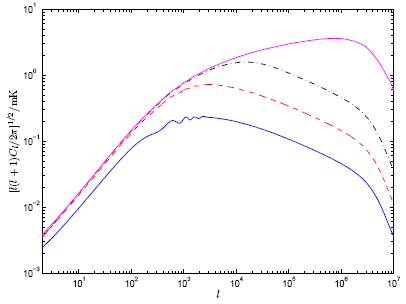
Features:The paper for the counts calculation is arXiv:1105.5292, and the main reference for the 21cm results is astro-ph/0702600 (BibTex).
- Dark age 21cm angular power spectra and transfer functions
- Angular power spectra for low-redshift source number counts (including redshift distortions and lensing)
- Lensing convergence power spectra from given window function (default: Gaussian)
- Use HALOFIT for non-linear corrections
- Various enhancements from CAMB for calculating high-l lensing potential and power spectra
- All cross-correlation power spectra (sources with themselves and with CMB)
- Full calculation and Limber approximation
- Baryon sound speed computed using evolved matter temperature perturbation
(hence transfer function more accurate than CAMB or CMBFAST on very small scales)- Use third-order perturbation theory to calculate non-linear CDM power (and estimate 21cm) at high redshift (use second_PT instead of Halofit)
- Sharp frequency windows for 21cm (via get_transfer=T)
- Calculation of perturbed recombination for accurate gas temperature perturbations and small scale baryons
- Inclusion of self-absorption terms, baryon velocity divergence during perturbed recombination
- Improved treatment of count power spectra, including potential terms; .ini options to calculate various parts separately; separate function for physical background source distribution
- (Apr 11) efficient lensing convergence power spectra to small scales. Output of full cross-covariance matrix, including polarization, CMB lensing and any sources. Full openmp parallelization. Added Matlab plotting/reading scripts.
- NEW: (Nov 13) Improved handling of Limber approximation, including for full cross-correlations and magnification bias. Updates to match latest CAMB version as closely as possible, including updated Halofit from arXiv:1208.2701 (significant increase in small-scale non-linear power) and CMB accuracy changes.